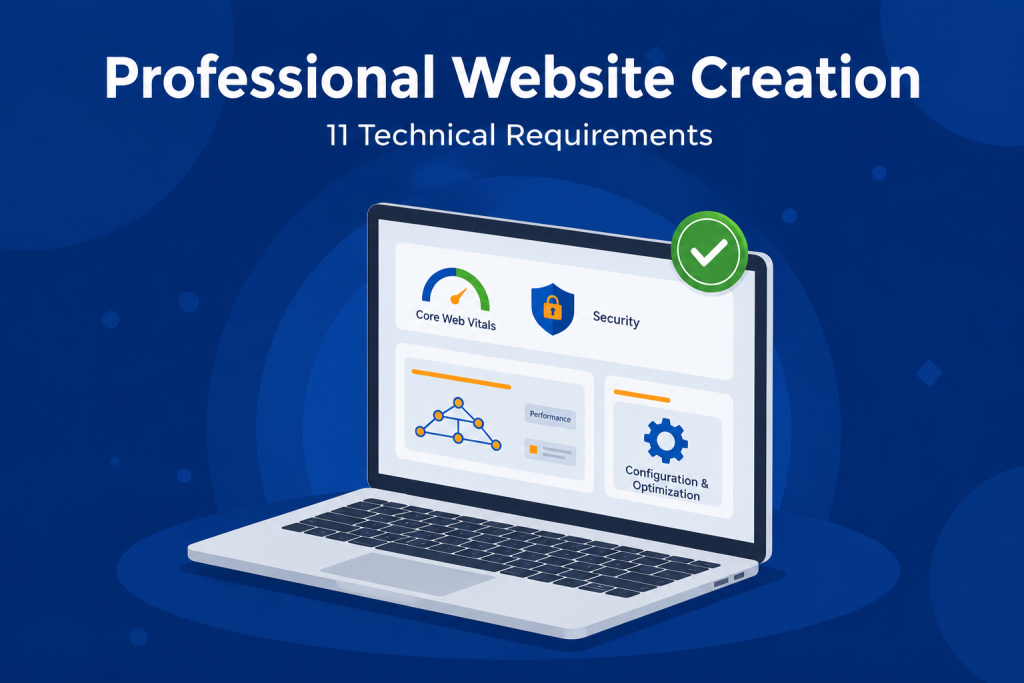
Below are the 11 essential technical requirements we apply at ID7 Studio to create websites that rank on Google, perform at scale, and generate measurable business results.
Tip: Throughout this article, we reference related resources and guides from our blog, including topics such as SEO for rebranding, fast and beautiful websites, WordPress maintenance, and other subjects directly connected to professional website development.
1) Information Architecture and Search Intent
A well-structured website architecture aligns navigation, content silos, and page hierarchy with the customer journey. This reduces unnecessary clicks, increases engagement time, and helps Google crawl and understand your site more efficiently.
- Logical sitemap structure: Home → Services → Case Studies → Blog → Contact
- Short, semantic URLs: /service/solution, /blog/topic-keyword
- Consistent navigation menus and breadcrumbs
Related reading: Website Development and our technical guide to SEO for rebranding to avoid losing rankings during structural changes.
2) Real Performance: Optimizing LCP, CLS, and INP
Core Web Vitals directly impact SEO and conversions. For a professional website, your performance goals should include:
- LCP < 2.5s
- CLS < 0.1
- INP < 200ms
- Optimized images using AVIF/WebP formats with lazy loading
- Inline critical CSS and deferred non-essential JS/CSS
- Preloaded fonts and use of system fonts whenever possible
This strategy aligns with our article on Fast and Beautiful Websites and our performance-focused approach to website development.
3) Infrastructure and Edge Caching
The right hosting environment and CDN drastically reduce global latency and improve stability.
- CDN with HTTP/3 + QUIC and edge HTML caching
- Brotli compression, TLS 1.3, automatic image caching and minification
- Web Application Firewall (WAF) and DDoS mitigation
4) Technical SEO: Sitemap, Robots, Canonicals, and 301 Redirects
Without a proper technical SEO foundation, Google cannot fully understand your website structure. In our guide to SEO for rebranding, we explain why correct 301 redirects and canonical tags are essential.
- Updated XML sitemap submitted to Google Search Console
- Properly configured robots.txt file
<link rel="canonical">implemented across all pages- Clean 301 redirects without redirect chains
5) Content Architecture and E-E-A-T
Content built on real expertise, examples, and trustworthy information reduces friction and accelerates buying decisions.
- Service pages with testimonials, FAQs, and comparisons
- Supporting blog articles around primary keywords like “professional website development”
- Clear author attribution, policies, and contact information
Related topics: Visual Identity and Logo Design — strong branding enhances E-E-A-T signals.
6) Conversion Optimization (CRO) and UX
Higher conversion rates mean lower customer acquisition costs.
- Primary CTA above the fold and repeated strategically throughout the page
- Short forms with clear validation and nearby social proof
- Live chat or WhatsApp integration without compromising SEO or performance
See also our guide on integrating WhatsApp into websites without harming SEO performance.
7) Security and Reliability
Website security directly impacts rankings, trust, and operational stability.
- Strict HTTPS implementation (HSTS), cookie policies, and security headers
- Versioned backups and staging environments for updates
- Active monitoring systems and WAF protection
Related article: How to Update and Maintain a WordPress Website Properly.
8) WordPress Governance and Maintainability
A professional WordPress website requires governance to scale safely and efficiently.
- Lightweight themes without vendor lock-in
- Minimal, well-maintained plugins
- Technical documentation and component guidelines
- Staging-based updates with basic automated testing
Resources: WordPress Recovery Services and our maintenance guide on the blog.
9) Visual Content: Performance and Brand Consistency
Images and videos must align with brand standards while remaining optimized for speed.
- AVIF/WebP export formats with properly configured
srcsetandsizes - Standardized 3:2 layouts for blog visuals to improve CTR
- Compression optimized without harming typography readability
Read our article: Visual Identity Guidelines.
10) Analytics and Business Metrics
If you don’t measure, you can’t improve.
- GA4 event tracking for leads, WhatsApp clicks, and form submissions
- Google Search Console performance monitoring
- Heatmaps and session recordings to identify UX friction points
11) Content Scalability and Internal Linking
Build content clusters around your main service keywords and supporting topics.
For example, around the keyword “professional website development”, create related content about:
- Website performance optimization
- Sitemap and canonical implementation
- Website migration strategies
- Technical SEO best practices
Use bidirectional internal linking between supporting articles and your main service pages, and implement FAQ schema to target Google’s “People Also Ask” results.
Quick Checklist for Professional Website Development
- Information architecture mapped around search intent
- Core Web Vitals optimized (LCP, CLS, INP)
- CDN + edge caching + Brotli + HTTP/3
- Correct sitemap, robots, canonicals, and 301 redirects
- E-E-A-T signals: author, trust elements, policies, contact info
- Clear CTAs and optimized forms
- Security: HSTS, WAF, backups, staging
- Lean WordPress governance with minimal plugins
- Optimized and standardized visuals
- GA4 + Search Console + heatmaps configured
- Strategic internal linking structure
Related Articles from Our Blog
- SEO for Rebranding: A Technical Guide to Preserving Rankings
- Fast and Beautiful Websites: Balancing Form and Function
- How to Integrate WhatsApp into Your Website the Right Way
- Visual Identity Guidelines for Strong Brands
- How to Properly Maintain a WordPress Website
How Much Does a Professional Website Cost?
Well-executed corporate websites typically range from US$1,000 to US$3,000. Projects involving CMS integrations and advanced functionality often range between US$2,000 and US$6,000. Custom e-commerce platforms and enterprise portals usually exceed US$6,000.
The ideal investment depends on strategy, performance requirements, content production, and long-term scalability.
Conclusion
Professional website development is not just about aesthetics — it’s about building a technical foundation that reduces customer acquisition costs, improves conversions, and supports sustainable organic growth.
By implementing these 11 technical requirements, your business gains stronger SEO performance, better user experience, and higher long-term ROI.
About ID7 Studio
ID7 Studio is a digital design and marketing agency focused on organic Google performance. For more than 14 years, we’ve combined visual identity, website development, and strategic SEO to build scalable, high-performing brands.
Request a quote for a free project assessment.